International SMS Messaging
from Korea, Global delivery
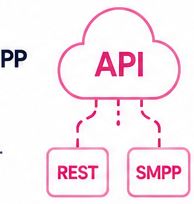
Send OTP, notifications, alerts, and customer messages to 200+ countries through SureM's global SMS infrastructure, REST API, or SMPP integration.


Why SureM for international SMS?
Most international SMS providers route Korea-bound messages through third-party hubs — which Korean carriers deprioritize or filter. SureM operates direct contracts with SKT, KT, and LG U+, the only path for consistent Korean SMS delivery without third-party hub routing.

Who is this service for?
One integration for teams sending across borders.




Common use cases
How to get started

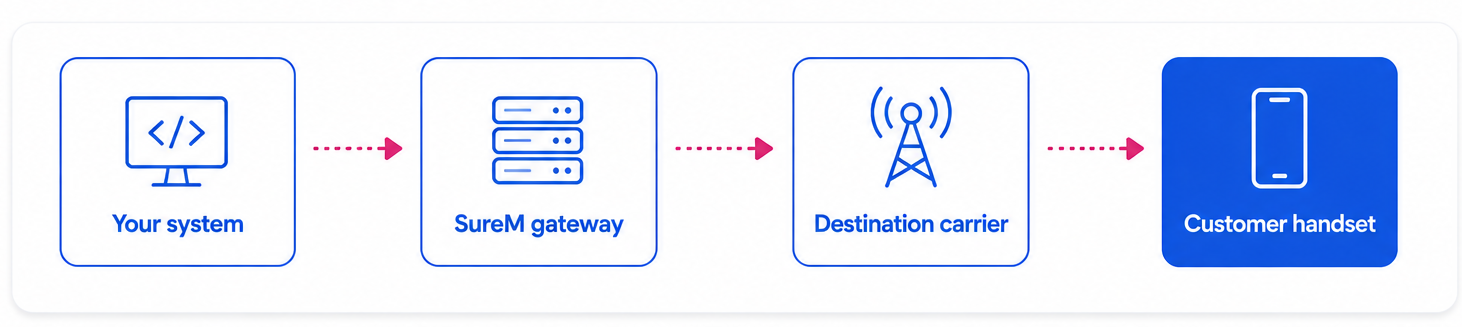
How message delivery works
International SMS strengths






Ways to send
Choose the method that fits your business and technical needs.
 Real-time messagingRESTful APIEasy integrationHigh throughputStable & reliableEnterprise readyEasy to useUpload & sendTrack & manage
Country-specific compliance
How international SMS pricing works
Pricing can vary by destination country, carrier route, sender requirements, message encoding, commercial model, and traffic volume.






Sender ID & delivery reports


Detailed policies are available in the API Docs or FAQ below.
Simple API request example
For developers integrating transactional messaging.
{
    "type": "SMS",
    "from": "SureM",
    "to": ["+819012345678"],
    "message": "Your verification code is 483920. Valid for 5 minutes."
}
For developers integrating transactional messaging.
Frequently asked questions
 What is the maximum character limit for international SMS?

Standard international SMS supports up to 160 characters using GSM-7 encoding (Latin alphabet). For Korean, Chinese, Japanese, Arabic, and other non-Latin scripts, UCS-2 encoding is used, which supports up to 70 characters per message. Messages exceeding these limits are automatically split into multiple segments and reassembled on the recipient's device as a single concatenated message (C-SMS).
Can I send Korean characters in international SMS without character corruption?
Yes. SureM uses UCS-2 encoding to deliver Korean, Chinese, Japanese, Arabic, and 20+ other languages without character corruption. Character corruption — where text appears as garbled symbols — is a common issue with providers that use non-Unicode routing. SureM's UCS-2 pipeline ensures your message arrives exactly as written, regardless of destination country or carrier.
How does SureM deliver SMS to South Korean phone numbers?
SureM operates direct carrier connections to South Korea's three major mobile operators — SKT, KT, and LG U+ — with no third-party hub routing. Most international SMS providers route Korea-bound messages through intermediary hubs, which Korean carriers deprioritize or filter as potential spam. SureM's direct interconnection supports throughput of 10,000+ messages per second and integrates Korea's NPDB (Number Portability Database) for accurate delivery to ported numbers.
Does SureM support two-way (inbound and outbound) international SMS?
Yes. SureM supports both outbound messaging (Korea to international, 200+ countries) and inbound messaging (international to Korea) through direct carrier connections to SKT, KT, and LG U+. Inbound SMS enables use cases such as two-way customer conversations, mobile number verification, and reply-based campaigns for international audiences communicating with Korean businesses.
What countries require sender ID (SID) pre-registration for SMS delivery?
Several countries enforce sender ID registration requirements that affect deliverability. Key examples include:
- Singapore: Sender ID pre-registration via a local entity is mandatory. Unregistered sender IDs are automatically labeled [Likely-SCAM] by Singapore carriers.
- China: Sender ID and message content must be pre-registered. Messages containing prohibited content categories (gambling, politics, adult content) are blocked automatically. An opt-out phrase (拒收请回复R) is required at the end of promotional messages.
- Vietnam: Sender ID pre-registration is strongly recommended. Only pre-approved message templates are accepted for bulk delivery.
SureM provides country-specific compliance guidance and sender ID registration support as part of the onboarding process.
What is the difference between SMS, C-SMS, and LMS?
SMS (Short Message Service) supports up to 160 characters (GSM-7) or 70 characters (UCS-2) in a single message segment. C-SMS (Concatenated SMS) automatically combines multiple SMS segments into a single message for the recipient, supporting up to 500 characters — suitable for order confirmations, reservation details, and longer notifications. LMS (Long Message Service) is a Korea-specific message type supporting up to 2,000 bytes of text, used for domestic Korean messaging where extended content is required.
Start sending
international SMS
Talk with SureM's messaging specialists.
We’ll help design the right workflow for your business.
SureM helps global messaging partners, foreign-invested companies in Korea, and Korean enterprises deliver SMS, LMS, MMS, RCS, Kakao, WhatsApp Business, Voice OTP,
and international messages through reliable local network connectivity and global messaging reach.