How Businesses Can Use SMS, LMS, and MMS for Different Customer Communications
Businesses communicate with customers throughout the entire customer journey — from account registration and order confirmation to delivery updates, promotions, and important service announcements.
However, not every message needs the same format.
A short verification code does not require the same messaging format as a detailed customer notice or a promotional message with an image.
This is where SMS, LMS, and MMS can each serve a different purpose.
Understanding how to use each messaging format can help businesses deliver clearer information while creating a better communication experience for their customers.
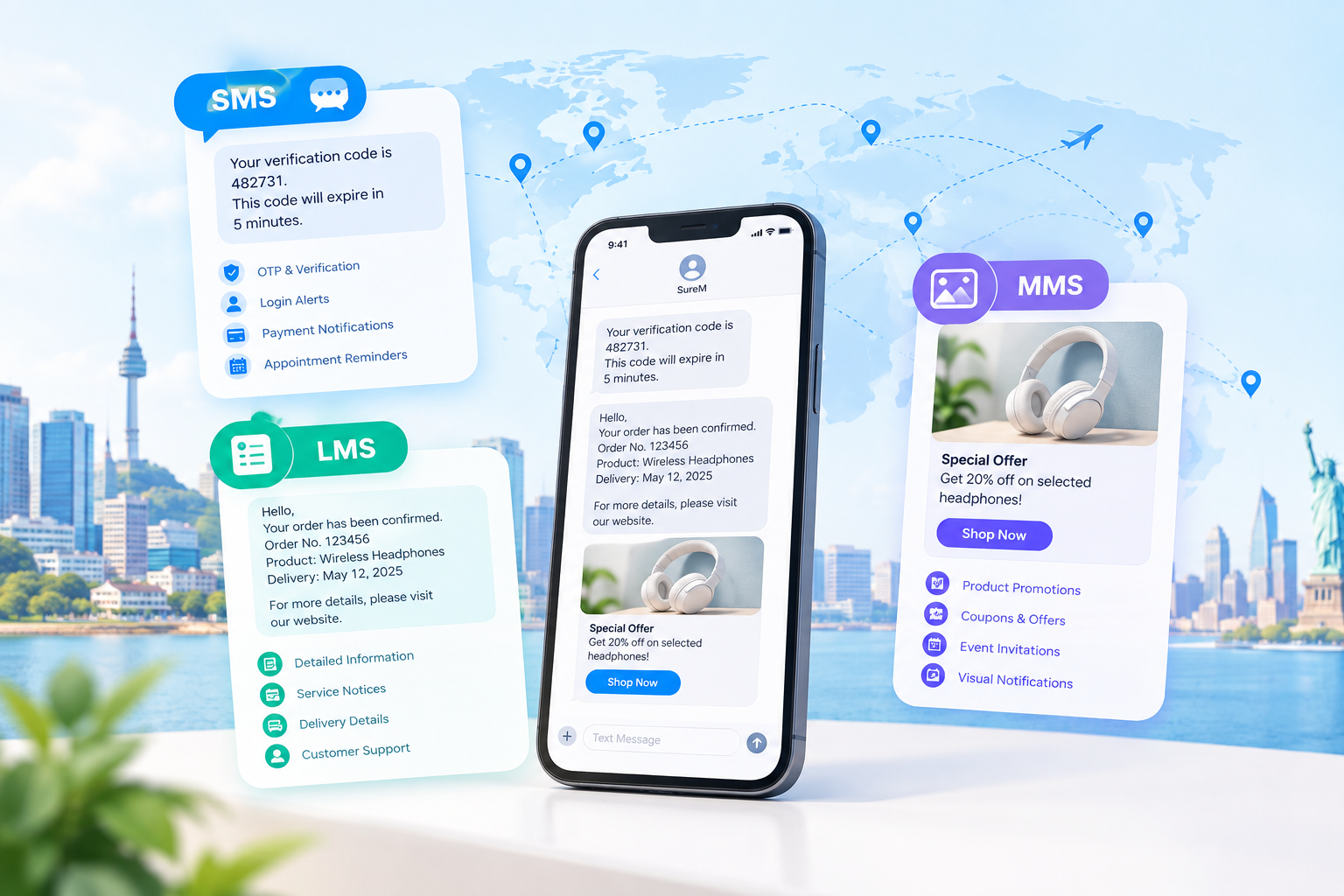
SMS for Short and Time-Sensitive Messages
SMS (Short Message Service) is designed for short, text-based communication.
Because the format is simple, SMS is commonly used when businesses need to deliver information quickly and clearly.
Typical SMS use cases include:
OTP and verification codes
Login notifications
Payment alerts
Order confirmations
Appointment reminders
Shipping notifications
Security alerts
For example, when a customer creates an account on a global application, the company may send a short OTP by SMS to verify the customer's mobile number.
In situations where the customer only needs one piece of important information, a concise SMS can be more practical than a longer message.
LMS for More Detailed Information
Sometimes a business needs to provide more information than can comfortably fit into a short SMS.
This is where LMS (Long Message Service) can be useful, particularly for businesses communicating with customers in South Korea.
LMS allows businesses to send longer text-based messages and is commonly used for detailed notifications, service information, and customer notices. SureM's current service information describes LMS as a Korea-focused long-message format supporting up to approximately 2,000 bytes.
Common LMS use cases include:
Detailed order information
Appointment instructions
Service announcements
Reservation information
Delivery details
Customer notices
Longer promotional messages
For example, a hotel could use LMS to send a customer check-in information, reservation details, and important instructions in one message rather than separating the information into several short messages.
MMS for Visual Communication
MMS (Multimedia Messaging Service) allows businesses to combine text with images and other multimedia content.
This makes MMS particularly useful when visual information is an important part of the message.
Common MMS use cases include:
Product promotions
Coupons and special offers
New product announcements
Retail campaigns
Event promotions
Image-based notifications
Brand communication
For example, an e-commerce company launching a new product could include a product image together with promotional information.
Instead of describing the product entirely through text, MMS allows the business to present the information visually.
SureM provides MMS as part of its business messaging services, including image-based customer communication and promotional messaging.
One Customer Journey Can Use Multiple Message Types
SMS, LMS, and MMS do not have to be used separately.
A business can use different formats at different stages of the customer journey.
For example:
Customer registration
→ SMS for OTP verification
Order confirmation
→ LMS for detailed order information
Delivery notification
→ SMS or LMS for status updates
Promotional campaign
→ MMS for product images and offers
This approach allows businesses to select the messaging format based on what the customer actually needs at each stage.
Choosing the Right Format for Your Message
The most important factor is not simply the length of the message. Businesses should also consider the purpose and content of the communication.
Use SMS when:
The information is short
The message is time-sensitive
The customer needs a code or simple notification
Use LMS when:
More text is required
The customer needs detailed information
The message contains instructions or multiple details
Use MMS when:
Images add value
The message is promotional
Visual presentation is important
Choosing the right format can help businesses avoid sending unnecessarily long messages while making important information easier for customers to understand.
SMS, LMS, and MMS for Global Businesses
For companies operating across multiple markets, messaging requirements can vary depending on the destination country.
A message format that works well in one market may not work exactly the same way in another. Local carrier requirements, message length, encoding, routing, and regulations can all affect business messaging.
This is particularly important for international businesses communicating with customers in South Korea.
SureM supports businesses with SMS, LMS, MMS, and international messaging, connecting Korean messaging infrastructure with global communication requirements. SureM currently provides international messaging across 200+ countries and 800+ carriers, alongside its Korea-focused messaging services.
One Messaging Partner for Different Business Needs
Customer communication is rarely limited to one type of message.
A business may need SMS for authentication, LMS for detailed notices, and MMS for promotional campaigns — sometimes within the same customer journey.
By choosing the appropriate messaging format for each situation, businesses can create a more organized and effective communication strategy.
SureM provides SMS, LMS, MMS, and international messaging services for businesses communicating with customers in Korea and around the world.
For international businesses entering Korea or Korean companies reaching overseas customers, SureM supports messaging infrastructure designed for both local and global communication.